✨ This article was AI edited. Editorial responsibility: MissJ.eu.
Produced with AI. This article was artificially generated. Editorial responsibility: MissJ.eu.
One of the greatest strengths of acrylic paint—its exceptionally rapid drying time—is simultaneously its most frustrating challenge for painters, miniature hobbyists, and craft enthusiasts. Because acrylic paint dries via simple water evaporation, open dollops on a traditional plastic, wooden, or glass palette will skin over in 10 to 15 minutes and become completely rock-hard within an hour, wasting expensive pigments and ruining custom color mixes.
Fortunately, mastering a few professional studio techniques, studio humidity controls, and specialized equipment can keep your acrylic paints workable for hours during active sessions and fresh for weeks between painting days. In this comprehensive guide, we examine wet palette technology, acrylic retarders, airtight storage solutions, and how to revive thick paint safely.
The Chemistry Behind Acrylic Paint Dehydration
Acrylic paint is a water-based polymer emulsion. When exposed to ambient room air:
- Evaporative Stage: Water molecules in the paint matrix evaporate rapidly into the surrounding air.
- Polymer Coalescence: As water volume decreases, suspended spherical acrylic polymer resin particles are forced into close contact with one another.
- Irreversible Film Formation: The polymer chains interlock and fuse chemically into an insoluble, waterproof plastic film. Critical Rule: Once acrylic has fully cross-linked and cured, adding water will not re-dissolve the paint. Prevention is the only solution.
Proven Methods to Prevent Acrylic Paint from Drying Out
| Method / Tool | Working Time Extension | Best Use Case | Pros & Considerations |
|---|---|---|---|
| Stay-Wet (Wet) Palette | Days to several weeks (with sealed lid) | Miniature painting, fine detail work, long canvas sessions | Keeps paint consistency 100% stable through capillary action |
| Fine Mist Spray Bottle | 1 to 3 hours during active painting | Large canvas blending, studio easel work | Inexpensive; requires misting every 15–20 minutes |
| Acrylic Retarder / Slow-Dri Medium | Doubles or triples open time (30–60 min open) | Wet-on-wet blending, portrait transitions, smooth skies | Must not exceed 15% ratio to avoid sticky, uncurable paint |
| Airtight Storage Palette Cups | 2 to 6 months | Saving custom pre-mixed color batches and glazes | Airtight silicone seals prevent moisture loss completely |
How to Build a DIY Wet Palette in 5 Minutes
You do not need to buy an expensive commercial wet palette; you can construct a professional-grade version using household items:
- Container: Take a shallow, airtight plastic food storage container (like Tupperware or a sandwich box).
- Sponge Base: Cut a flat cellulose kitchen sponge or a layer of folded paper towels to fit the bottom of the container.
- Add Distilled Water: Saturate the sponge with clean distilled water until it is fully soaked, then pour off excess standing water.
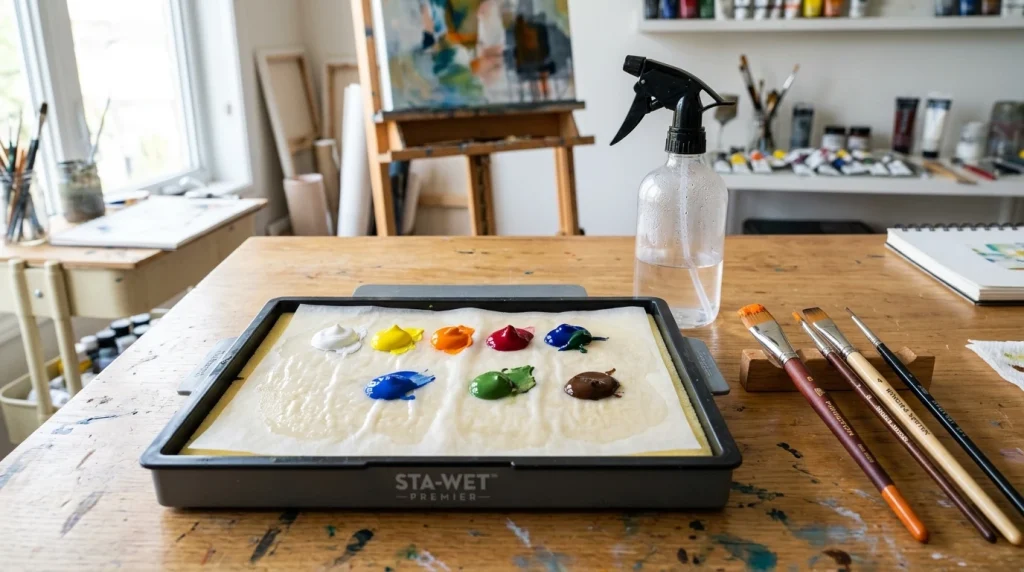
- Membrane Paper: Cut a sheet of non-waxed kitchen parchment paper (baking paper) and place it smoothly on top of the wet sponge. Smooth out any trapped air bubbles.
- Palette Ready: Dispense your acrylic paint directly onto the parchment paper. The semi-permeable parchment pulls moisture upward via capillary action, keeping your paint perfectly fresh for days. Snap the airtight lid on when done to preserve mixes for weeks.
Using Acrylic Retarder Safely
Acrylic retarder (glycol-based fluid) slows the evaporation rate of water. However, crafters must observe the 15% Rule:
- Mix no more than 1 part retarder to 6 parts acrylic paint (approx. 15% maximum).
- Excessive retarder permanently destroys the polymer binding capacity, leaving the paint tacky, weak, and susceptible to peeling off the surface.
How to Store Paint Tubes & Prevent Dried Nozzles
- Always wipe the threaded neck of acrylic tubes with a damp cloth before screwing caps back on.
- Store tubes nozzle-down in organizers so any minor dried plugs stay confined to the tip while fresh paint remains sealed inside.
- Wrap nozzle threads with Teflon plumbing tape for jars that will sit unused for months.
Frequently Asked Questions
Can I revive acrylic paint that has dried completely hard on the palette?
No. Once acrylic paint has fully cross-linked into a solid plastic polymer, it cannot be reconstituted with water or mediums. If the paint is only skin-deep (a thin dried crust with wet paint underneath), you can puncture the surface skin and extract the usable wet paint beneath.
Why does my wet palette develop mold or bad smells?
Stagnant tap water combined with organic pigments can harbor mold over time. To prevent this, always use distilled water in your wet palette and place a clean copper penny or a drop of tea tree oil beneath the sponge (copper and tea tree have natural antimicrobial properties).
Can I put acrylic paint in the refrigerator or freezer?
Refrigerating a sealed wet palette slows water evaporation and inhibits mold growth, keeping paints fresh even longer. However, never freeze acrylic paint; freezing temperatures break the acrylic chemical emulsion, turning the paint into an unusable cottage-cheese curd texture.
Comprehensive Acrylic Drying Retarders & Mediums Guide
Understanding the exact chemical role of additives allows you to manipulate drying times with surgical precision:
| Additive Type | Active Mechanism | Maximum Safe Ratio | Effect on Sheen / Body |
|---|---|---|---|
| Slow-Dri Fluid Retarder | Glycol humectant slows water evaporation rate | 15% by volume | No effect on finish; slightly increases flow |
| Glazing Liquid (Gloss/Satin) | Acrylic resin with built-in retarder emulsion | Any ratio (up to 90% for thin transparent glazes) | Increases transparency and luminous depth |
| Flow Improver / Surfactant | Breaks water surface tension for stain washes | 1 part improver to 20 parts water | Increases absorption into canvas without foaming |
Studio Environmental Controls for Slower Drying
Your studio’s microclimate plays a massive role in how fast acrylic paints dry:
- Use an Ultrasonic Humidifier: Maintaining 50% to 60% ambient relative humidity in your painting space dramatically slows surface evaporation without altering paint chemistry.
- Avoid Direct Air Currents: Keep your easel away from oscillating fans, air conditioner vents, and heat registers.
- Cover with Cling Wrap During Breaks: When stepping away for 30 minutes, mist your palette lightly and drape a sheet of plastic cling film directly over your paint mounds.
Get our latest guides, news, and insights highlighted in your Google Search & AI Overviews.