✨ This article was AI edited. Editorial responsibility: MissJ.eu.
Produced with AI. This article was artificially generated. Editorial responsibility: MissJ.eu.
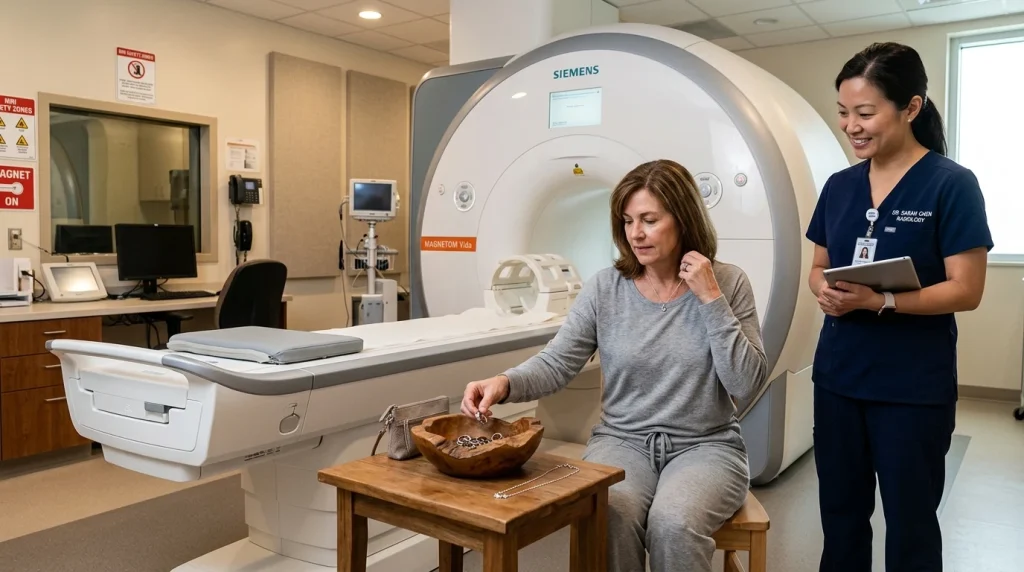
Preparing for a diagnostic imaging appointment frequently brings practical questions regarding personal attire and accessories: do I need to remove jewellery before my scan?
The clear, medically necessary answer is yes, you must remove all jewelry, body piercings, hairpins, and metallic accessories prior to diagnostic scans. Depending on whether your scan is an MRI (Magnetic Resonance Imaging), CT (Computed Tomography) scan, or standard X-ray, wearing metal poses significant risks ranging from violent magnetic projectile hazards and severe RF thermal burns to diagnostic image blinding (streak artifacts). In this clinical radiologist-backed guide, we break down scanning physics, metal risks, body piercing management, and hospital locker protocols.
Diagnostic Scan Comparison: Why Metal Causes Hazards
| Scan Modality | Imaging Technology | Primary Metal Hazard | Jewelry Removal Policy |
|---|---|---|---|
| MRI Scan (Magnetic Resonance) | 1.5T – 3.0T Superconducting Magnet + Radiofrequency (RF) Pulses | Catastrophic: Projectile attraction, RF inductive heating burns, violent torque | 100% Mandatory Removal (All metals, non-ferrous included) |
| CT Scan (CAT Scan) (Computed Tomography) | Rotating ionizing X-ray beam + 3D computer reconstruction | Diagnostic: Starburst streak artifacts obscure tumors, fractures, and blood vessels | Mandatory in the scan field of view (head, neck, chest) |
| Standard X-Ray (Radiography) | Static 2D X-ray projection | Superimposition: Dense metal casts solid white shadows masking bone anatomy | Mandatory on the anatomical region being imaged |
The 3 Major Physical Risks of Jewelry During Scans
1. The Missile (Projectile) Effect in MRI
An MRI scanner contains a massive superconducting electromagnet operating at 1.5 to 3.0 Tesla (30,000 to 60,000 times stronger than Earth’s magnetic field). The magnet is always active 24/7, even when the machine is not scanning. Ferromagnetic items (steel, iron, nickel) will be ripped off the body at bullet-like speeds toward the center bore, causing catastrophic injury.
2. Radiofrequency (RF) Inductive Heating & Thermal Burns
Even non-ferromagnetic precious metals like pure 925 sterling silver, solid 14k gold, and platinum pose severe RF heating risks. The scanner’s rapidly oscillating radiofrequency magnetic fields induce electrical currents (eddy currents) in closed metal loops (rings, circular hoops, necklace chains). In seconds, these currents can heat metal jewelry to over 150°F (65°C), causing full-thickness third-degree skin burns.
3. Image Blinding (Metal Artifacts)
In CT scans and X-rays, high-density precious metals absorb all X-ray photons, creating dramatic black-and-white “sunburst” streaks across the image. A single overlooked earring or necklace clasp can completely obliterate critical diagnostic views of the brain, spinal cord, or thyroid gland, forcing repeat scans and unnecessary radiation exposure.
Handling Body Piercings, Rings & Permanent Jewelry
- Tight / Swollen Rings: If an engagement or wedding band is stuck on a swollen knuckle, notify the technologist immediately. Technologists use the elastic ribbon wrap method or mild Windex/soapy lubricant to slip the ring off without cutting.
- Body Piercings & Retainers: For unhealed piercings that cannot be left empty, switch metal jewelry to biocompatible PTFE, medical-grade silicone, or quartz glass retainers 24 hours prior to your scan.
- Welded Permanent Jewelry: If you wear permanent micro-welded gold bracelets, ask your radiologist. If scanning the head or knee, distal permanent jewelry on the wrist may be cleared if taped flat; for MRI scans of the torso/arm, the jump ring must be clipped and re-welded later.
Frequently Asked Questions
Can I wear gold or sterling silver jewelry in an MRI?
No. While pure gold and silver are non-magnetic (diamagnetic), they are exceptional electrical conductors. MRI radiofrequency pulses can induce rapid electric currents in precious metal rings and chains, resulting in dangerous thermal skin burns.
Are titanium and surgical steel piercings safe in an MRI?
Implant-grade titanium (ASTM F-136) is MRI-conditional and non-magnetic. However, “surgical steel” (316L) contains trace amounts of nickel and ferrite that can heat up or create massive image artifacts. When in doubt, technologists require all metal piercings to be removed.
What should I do with my valuables during a hospital scan?
Leave precious jewelry, luxury watches, and family heirlooms safely at home. If you must bring them to the imaging center, hospitals provide secure lockers with keys you keep during the examination.
Pre-Scan Attire & Hidden Metal Checklist
Modern clothing frequently incorporates hidden metallic components that patients overlook before entering the radiology suite. Review this comprehensive inspection checklist:
| Clothing / Accessory Item | Hidden Metal Element | Hazard Level | Recommended Alternative |
|---|---|---|---|
| Athletic Leggings & Yoga Tops | Microscopic anti-odor silver / copper antimicrobial threading (e.g. Lululemon Silverescent) | Severe RF Burn Risk: Conductive metal threads heat rapidly in MRI | 100% plain cotton sweatpants or hospital gown |
| Underwire Bras | Steel underwire support + metal strap adjusters and hooks | Torque displacement + chest image blinding | All-fabric sports bra with zero metal hooks or plastic fasteners |
| Hair Accessories & Makeup | Bobby pins, metallic hair elastics, magnetic false eyelashes | Projectile missile hazard + eyelid tearing | Pure fabric scrunchies; arrive without eye makeup or metallic eyeshadow |
Special Considerations for Tattoos & Permanent Makeup
Older or foreign cosmetic tattoos (microblading, permanent eyeliner) and traditional tattoos may contain metallic iron oxide pigments. During high-field 3T MRI scans, these pigments can experience minor tingling or mild thermal irritation. Inform your technologist; they will place a cool, damp washcloth over the tattooed region to dissipate any RF heat buildup during the sequence.
Get our latest guides, news, and insights highlighted in your Google Search & AI Overviews.