✨ This article was AI edited. Editorial responsibility: MissJ.eu.
Produced with AI. This article was artificially generated. Editorial responsibility: MissJ.eu.
Sublimation on acrylic time and temp requires heat-pressing cast acrylic blanks at 385°F to 400°F (196°C to 204°C) for 60 to 75 seconds under light-to-medium pressure (20 to 30 PSI). Because extruded acrylic melts under direct dye-sublimation heat, specialized sublimation-grade cast acrylic blanks with a heat-resistant white polymer coating are mandatory to prevent warping while gasifying disperse dyes.
Dye sublimation on clear and white acrylic has revolutionized custom handmade crafts, jewelry charms, keychains, and photo plaques. Unlike vinyl overlays that peel over time or UV printing that can scratch off, sublimation infuses vaporized disperse dyes directly into the polymer matrix at high temperatures, creating scratch-proof, waterproof, full-color imagery. However, acrylic is a thermoplastic material with a relatively low melting threshold compared to ceramics or metals. If your heat press time and temperature parameters are off by even 10 degrees or 15 seconds, your blanks will warp, bubble, or develop yellow scorched edges.
Master Time and Temperature Reference Chart
Different blank thicknesses and coating styles require adjusted thermal parameters. Use this master calibration chart for your heat press:
| Acrylic Blank Type & Thickness | Temperature (°F) | Temperature (°C) | Pressing Time | Pressure Setting | Peel Method |
|---|---|---|---|---|---|
| Standard White-Coated Acrylic (3 mm / 1/8″) | 385°F–390°F | 196°C–199°C | 60–70 Seconds | Light (20 PSI) | Warm peel immediately |
| Heavy Cast Acrylic Charms (4–5 mm) | 390°F–400°F | 199°C–204°C | 70–80 Seconds | Light-Medium (25 PSI) | Warm peel |
| Clear Acrylic with White Sublimation Backing | 380°F–385°F | 193°C–196°C | 55–65 Seconds | Very Light (15–20 PSI) | Cool peel under weight |
| Double-Sided Sublimation Acrylic Ornaments | 375°F–380°F | 190°C–193°C | 50–60 Sec / Side | Light (20 PSI) | Cool between presses |
Cast Acrylic vs. Extruded Acrylic: The Fatal Mistake
The most common reason for failed sublimation is attempting to press hardware-store acrylic sheets. Acrylic is manufactured via two fundamentally distinct processes:
- Extruded Acrylic: Manufactured by rolling plastic mass through mechanical dies. It has a low melting point (around 320°F / 160°C) and contains zero dye-receptor coating. When subjected to 400°F sublimation heat, extruded acrylic liquefies, bubbles, and adheres permanently to your heat platen. Never attempt sublimation on standard extruded acrylic.
- Cast Acrylic (Sublimation-Grade): Liquid polymethyl methacrylate is cast between glass plates and fully cross-linked. It withstands temperatures up to 410°F (210°C) without thermal breakdown. True sublimation acrylic blanks feature a factory-applied, micro-porous polyester or polyurethane white coating on the back face that permanently absorbs sublimation dye gas.
Step-by-Step Sublimation Process for Flawless Acrylic Blanks
- Remove the protective film: Sublimation acrylic blanks ship with clear blue or brown paper protective masking on both sides. You must peel this protective film off the white sublimation side before pressing. Failure to remove the film will fuse molten plastic to your transfer paper.
- Print in mirror mode: Print your high-resolution graphic onto premium sublimation transfer paper using sublimation inks. Always mirror your design horizontally, especially for clear acrylic where the image is viewed through the transparent front face.
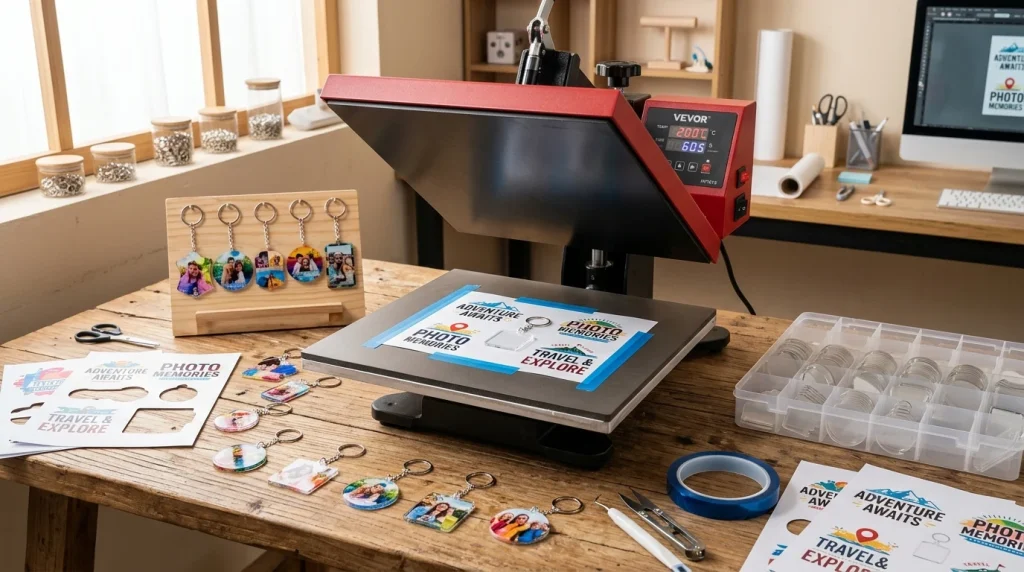
- Secure with thermal tape: Position the blank onto your printed transfer with the white coated side facing the ink. Secure all four edges with high-temperature thermal tape to eliminate ghosting caused by paper shift when opening the press.
- Prepare your sandwich stack:
- Bottom layer: Clean blowout butcher paper.
- Middle layer: Sublimation transfer with acrylic blank on top (paper on bottom, white coating facing paper, or paper on top if your press heats from above).
- Top layer: Clean blowout butcher paper (protects your upper heat platen from stray dye vapors).
- Press with calibrated light pressure: Close your heat press at 385°F for 65 seconds under light pressure. Heavy pressure crushes heated acrylic and squeezes softened edges outward.
- Immediate cooling under weight: Acrylic remains soft and malleable for approximately 90 seconds after pressing. Transfer the hot blank immediately to a flat, clean metal or wooden surface, and place a heavy, flat object (like a solid metal block or heavy book) on top until the acrylic cools to room temperature. This guarantees a razor-flat finished product with zero warping.
Troubleshooting Common Acrylic Sublimation Defects
| Defect / Symptom | Root Cause | Corrective Action |
|---|---|---|
| Warped, curved edges | Uneven cooling or excessive heat press pressure | Reduce pressure to 20 PSI; place under heavy flat weight immediately after pressing until cold. |
| Yellowing or scorched borders | Temperature above 405°F or dwell time exceeded | Lower heat press temperature by 10°F–15°F and reduce dwell time to 60 seconds. |
| Faded, dull colors | Under-temperature or insufficient dwell time | Increase press time by 10 seconds; verify platen temperature with a digital infrared thermometer. |
| Blurry ghost images | Transfer paper shifted during opening | Use heat-resistant thermal tape on all edges; open heat press slowly and smoothly. |
| Bubbles on the clear surface | Trapped moisture or plastic protective film left on | Ensure protective masking is removed; pre-warm blanks for 10 seconds at 300°F to dry ambient humidity. |
Complementary Crafting & Jewelry Resources
- Learn how to maintain acrylic accessories with our guide on professional jewellery cleaning techniques.
- Understand the structural nature of acrylic in our technical overview on decoding acrylic jewelry materials.
- Explore proper craft storage by reading our guide to jewellery storage solutions that protect and display.
Frequently Asked Questions
Can you sublimate directly onto clear acrylic without a white coating?
No, sublimation dye is transparent and requires a white background to reflect light and display vibrant contrast. Furthermore, raw acrylic does not contain sufficient polyester polymer chains to bind dye molecules without a specialized sublimation coating. Clear blanks designed for sublimation include a translucent or opaque white receptive backing.
Do you sublimate acrylic face-up or face-down?
For clear acrylic photo blocks and charms, you sublimate onto the white-coated back side face-up (transfer paper placed against the white coating on top of the heat press bed). When viewed from the front, the artwork shines through the crystal-clear polished acrylic layer.
What temperature melts acrylic in a heat press?
Standard extruded acrylic begins deforming at 320°F (160°C) and melts into liquid paste above 360°F (182°C). High-grade cast acrylic can tolerate temperatures up to 400°F (204°C) for up to 80 seconds without melting, provided pressure is kept light.
Get our latest guides, news, and insights highlighted in your Google Search & AI Overviews.