✨ This article was AI edited. Editorial responsibility: MissJ.eu.
Produced with AI. This article was artificially generated. Editorial responsibility: MissJ.eu.
Whether caused by an enthusiastic painting session, a home renovation mishap, or a school art project, discovering acrylic paint splatters on your favorite shirt or jeans immediately sparks urgency: can you wash off acrylic paint from clothes?
The factual answer depends entirely on the state of the paint: wet acrylic paint washes off easily with warm water and soap, whereas fully dried acrylic paint requires targeted chemical solvents to break its synthetic polymer bonds. In this definitive textile care guide, we examine the molecular behavior of acrylic polymers on fabric fibers, provide step-by-step stain removal protocols for every stage, and break down the safest solvent treatments by fabric type.
How Acrylic Paint Binds to Fabric: The Chemistry of a Stain
Acrylic paint is an emulsion composed of color pigments suspended in an acrylic polymer resin with water as the solvent carrier. The removal process changes fundamentally depending on three distinct drying phases:
| Drying Phase | Chemical State | Water Solubility | Recommended Action |
|---|---|---|---|
| Phase 1: Wet Paint (0 – 20 minutes) | Polymer chains remain dispersed in water emulsion | 100% Water Soluble | Flush with warm running water and liquid dish detergent immediately |
| Phase 2: Skin-Dry / Curing (20 min – 24 hours) | Water evaporates; polymer particles fuse into a solid plastic film | Insoluble in Water | Apply 91% Isopropyl alcohol or hand sanitizer to dissolve polymer bonds |
| Phase 3: Heat-Set / Machine Dried (Fully cross-linked) | Thermal cross-linking locks plastic matrix into fiber pores | Hydrophobic & Wash-Proof | Spot-treat with pure Acetone or denatured alcohol on sturdy cotton/denim |
Protocol 1: How to Wash Off Fresh, Wet Acrylic Paint
If you catch the paint while it is still wet to the touch, follow these rapid steps:
- Scrape Excess: Use a dull butter knife or edge of a spoon to gently lift off surface blobs without pressing paint deeper into the fabric weave.
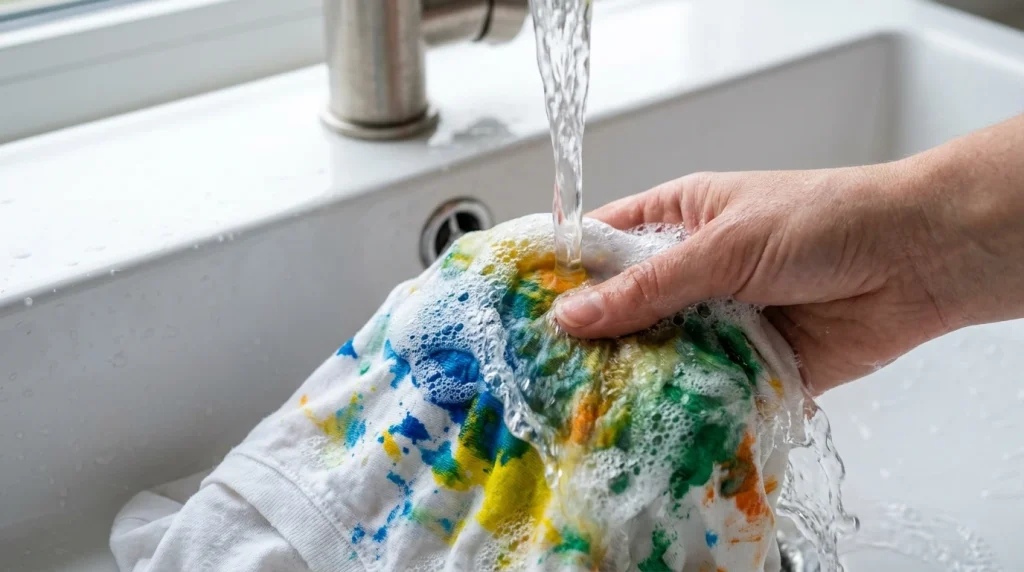
- Reverse Flush: Turn the garment inside out and run warm tap water directly through the back of the stain. This pushes pigment particles out of the threads rather than driving them inward.
- Lather with Degreasing Soap: Apply concentrated liquid dish soap (like Dawn) or liquid laundry detergent. Massage gently with fingertips or a soft baby toothbrush.
- Rinse & Launder: Rinse until water runs completely clear, then machine wash in warm water. Air dry (do not use the dryer until stain removal is 100% confirmed).
Protocol 2: How to Remove Dried Acrylic Paint with Isopropyl Alcohol
Because cured acrylic resin is chemically soluble in alcohol, isopropyl rubbing alcohol (70% or 91%) is the gold-standard household remedy for dried paint:
- Place a thick pad of folded paper towels directly beneath the stained fabric layer.
- Saturate the dried paint spot generously with 91% isopropyl alcohol or alcohol-based hand sanitizer.
- Allow the alcohol to dwell on the fabric for 3 to 5 minutes to soften the cross-linked polymer bonds.
- Use an old soft toothbrush to gently scrub in small circular motions. You will see the hardened plastic liquefy into a colored sludge and transfer downward into the paper towels.
- Rinse under warm water, apply laundry pre-treater, and machine wash.
Protocol 3: Heavy-Duty Acetone Treatment for Stubborn & Heat-Set Stains
For garments that have accidentally gone through the clothes dryer with paint, acetone dissolves cured acrylic plastic:
- CRITICAL WARNING: Never use acetone on acetate, triacetate, or modacrylic garments, as acetone instantly melts synthetic cellulose into sticky liquid goo.
- Test a hidden seam first for colorfastness.
- Dab pure acetone onto the stain using a cotton ball, working from outer edges toward the center.
- Blot continuously with clean white paper towels until no more color transfers, then immediately wash with heavy-duty detergent.
Fabric Compatibility Matrix for Solvent Treatments
| Fabric Material | Soap & Water | Isopropyl Alcohol | Acetone |
|---|---|---|---|
| 100% Cotton & Denim | ✔ Safe (Wet only) | ✔ Highly Recommended | ✔ Safe for stubborn stains |
| Polyester & Nylon | ✔ Safe | ✔ Safe | ⚠ Test first; may stiffen fibers |
| Wool & Silk | ✔ Delicate wash | ⚠ Gentle spot dab only | ❌ Prohibited (Damages protein fibers) |
| Acetate / Rayon Blends | ✔ Safe | ⚠ Spot test | ❌ STRICTLY FORBIDDEN (Dissolves fabric) |
Frequently Asked Questions
Does hairspray work on dried acrylic paint?
Yes, traditional aerosol hairspray works because it contains high concentrations of alcohol. However, 91% isopropyl rubbing alcohol is far superior because it contains no sticky polymers, oils, or perfumes that leave separate stains.
Can baking soda or vinegar remove dried acrylic paint?
No. Neither baking soda nor vinegar possesses the organic solvent power necessary to dissolve cross-linked acrylic polymer resin. Use isopropyl alcohol instead.
What if the clothing item is Dry Clean Only?
Do not apply water or household solvents to dry-clean-only fabrics like silk, cashmere, or structured suits. Take the item immediately to a professional dry cleaner and inform them that the mark is acrylic paint so they can apply specialized professional solvents.
Get our latest guides, news, and insights highlighted in your Google Search & AI Overviews.