✨ This article was AI edited. Editorial responsibility: MissJ.eu.
Produced with AI. This article was artificially generated. Editorial responsibility: MissJ.eu.
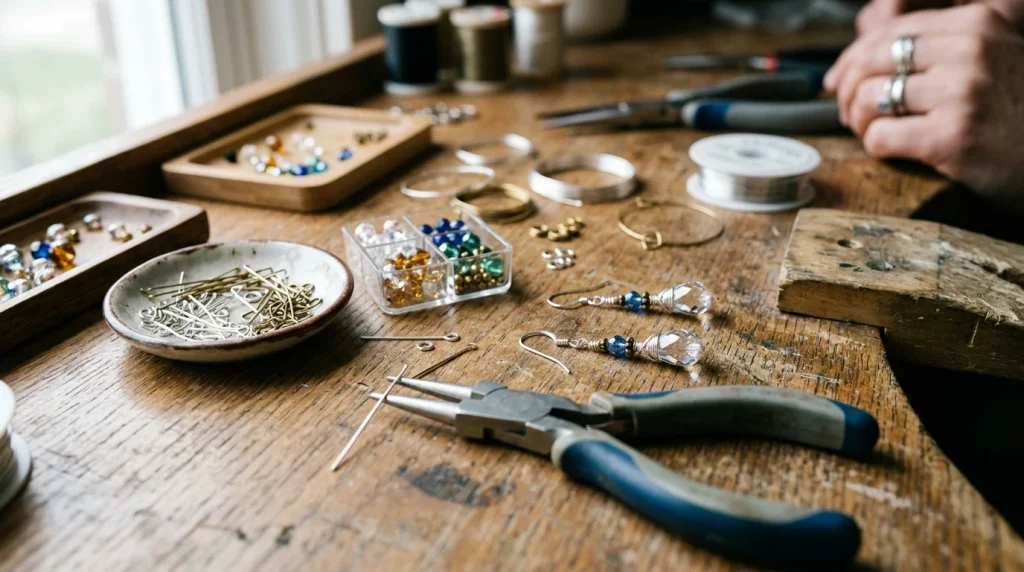
In the world of beadwork and artisan jewelry fabrication, head pins in jewelry making serve as the indispensable structural foundation for creating earrings, necklace drops, charm bracelets, and beaded dangles. A head pin is a slender length of wire with a stopper or decorative element on one end, designed to prevent beads from sliding off while allowing the artisan to create a secure hanging loop on the open end.
Despite their apparent simplicity, selecting the wrong wire gauge, metal temper, or head style can lead to bent components, loose loops, or metal fatigue failure. In this comprehensive guide, we examine the various types of head pins, gauge standards, metal compositions, and master techniques for creating both simple and wrapped wire loops.
Anatomy and Purpose of a Jewelry Head Pin
Unlike eye pins (which feature a pre-formed wire loop on one end to link between two components), a head pin terminates in a flat stopper, ball, paddle, or decorative motif. This makes head pins ideal for the final, bottom component in any vertical dangle design.
- The Head (Stopper): Prevents beads with standard drill holes from slipping off the wire.
- The Shaft: The straight length of wire where beads, crystals, or pearls are strung.
- The Working Tip: The open wire end cut to length and bent into a closed connection loop using jewelry pliers.
Head Pin Types & Styles Comparison
| Head Pin Style | Stopper Anatomy | Best Applications | Visual Aesthetic |
|---|---|---|---|
| Flat Head Pins | Small, flat stamped disc perpendicular to shaft | Standard beads, crystals, spacers where stopper should remain hidden | Clean, minimalist, unobtrusive |
| Ball Head Pins | Smooth, rounded spherical bead melted/soldered onto tip | Drop earrings, gemstone briolettes, high-end bridal jewelry | Elegant, polished, decorative |
| Paddle / Hammered Pins | Flattened paddle shape created by hammering the end | Artisan wire jewelry, boho designs, organic gemstone drops | Handcrafted, rustic, textured |
| Decorative / Cast Pins | Cast motifs (flowers, skulls, leaves, spiral filigree) | Vintage style dangles, themed charm collections | Ornate, statement focal point |
Understanding Wire Gauges for Jewelry Making
The gauge (AWG – American Wire Gauge) specifies the thickness of the head pin. Remember: in wire gauges, a higher number indicates a thinner wire:
- 20 Gauge (0.81mm): Sturdy, rigid wire. Ideal for heavy glass beads, large ceramic charms, and earring dangles that require extra structural support. Does not fit through tiny pearl or micro-faceted gemstone drill holes.
- 21-22 Gauge (0.64mm–0.71mm): The universal standard workhorse gauge. Fits 90% of commercial beads, crystals, and glass pearls while offering excellent loop strength.
- 24 Gauge (0.51mm): Slender, flexible wire. Essential for small freshwater pearls, semi-precious gemstones, and delicate wire-wrapped briolettes. Must be wrapped (not simple looped) to prevent bending under weight.
- 26 Gauge (0.40mm): Ultra-fine wire for tiny seed beads and micro-drilled gems. Requires multi-wrap secure loops.
Metal Composition & Temper Choices
The choice of metal alloy determines not only the visual finish of your handcrafted pieces but also the wire’s structural malleability (temper):
- Sterling Silver (.925): The precious metal standard. Offers an ideal half-hard temper that holds crisp loops while resisting deformation.
- 14k Gold-Filled: A thick layer of solid 14k gold mechanically bonded to a brass core. Far superior to gold plating, gold-filled head pins will not flake or tarnish with wear.
- Raw & Plated Brass: Inexpensive and easy to manipulate, perfect for fashion jewelry and costume designs.
- Stainless Steel & Titanium: Ultra-durable, corrosion-proof, and hypoallergenic. Requires heavy-duty tungsten carbide wire cutters due to metal hardness.
Step-by-Step Tutorial: Making Professional Wire Loops
Method 1: Creating a Standard Simple Loop
- String Your Beads: Slide your chosen beads and bead caps onto the head pin until snug against the stopper.
- Right-Angle Bend: Using chain nose pliers, grip the wire directly above the top bead and bend the wire 90 degrees sharply.
- Trim to Length: Measure approximately 8mm to 10mm (3/8 inch) from the bend and cut the excess wire using flush cutters (flat side of cutter facing the beads).
- Form the Circle: Grip the very tip of the wire with round nose pliers. Roll your wrist smoothly backwards toward the bend, curving the wire into a complete circular loop flush against the bead.
Method 2: Creating a Secure Wrapped Loop (High-End Durability)
Wrapped loops are significantly stronger than simple loops and will never pull open under tension, making them the industry standard for fine jewelry:
- Slide beads onto a head pin (ensure the pin is at least 1.5 to 2 inches long).
- Grip the wire with chain nose pliers 2mm above the bead and bend 90 degrees.
- Grip the corner of the bend with round nose pliers and wrap the wire over the top barrel to form a circle.
- Pass the working wire underneath the loop.
- Hold the loop firmly with flat nose pliers and use chain nose pliers to coil the tail wire tightly 2 to 3 times around the stem between the loop and the bead.
- Trim the remaining wire flush and tuck the tiny wire end with pliers.
Common Head Pin Problems & Fixes
- Bead Hole Too Large (Slips over head): Add a small 2mm metal spacer bead or seed bead at the base before adding your main bead.
- Head Pin Too Short: Switch to wire wrapping with bulk craft wire or make your own balled head pin with a micro torch.
- Bent Pins: Straighten crooked pins quickly by pulling them gently through nylon-jaw pliers.
Frequently Asked Questions
What is the difference between an eye pin and a head pin?
A head pin has a flat, ball, or decorative stopper at one end to hold beads at the bottom of a dangle. An eye pin has an open circular loop at one end, designed to link components together in sequence (such as in a rosary chain or bracelet segment).
Can I make my own ball head pins at home?
Yes. If you work with sterling silver, fine silver, or copper wire, you can hold a length of wire vertically with tweezers and heat the bottom tip with a butane craft torch. The metal will melt and surface tension will pull it into a perfect smooth sphere.
What metal head pins are best for sensitive ears?
For hypoallergenic earrings, choose sterling silver (.925), 14k gold filled, niobium, or medical-grade titanium head pins to prevent allergic contact dermatitis.
Get our latest guides, news, and insights highlighted in your Google Search & AI Overviews.